

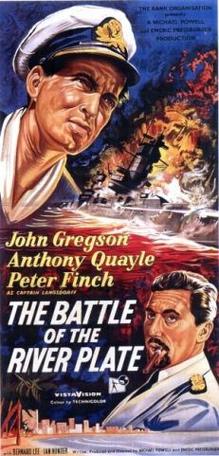

The British made some very good naval combat pictures set in WWII. Two of these are “The Pursuit of the Graf Spee” (1956) and “Sink the Bismarck” (1960). Both cover true events.
“The Pursuit of the Graf Spee” (also known as “The Battle of the River Plate”) was a Powell and Pressburger production and was their last big hit. It opens in November, 1939 in the Atlantic Ocean. The German pocket battleship Graf Spee is commerce raiding. The crew of the British merchant ship Africa Shell is brought on board. Capt. Patrick Dove (Bernard Lee) is introduced to Capt. Lansdorf (Peter Finch) and develops a relationship with him. Lansdorf is a bit pompous, but polite and respectful. He is not an evil Nazi. In fact, there is not an evil Nazi to be found on board.
Meanwhile the British fleet is setting a trap for the Graf Spee off the coast of Uruguay. Commodore Harwood (Anthony Quayle) holds a fictitious officer’s counsel with the other captains in a throwback to “the Nelson touch”. This scene is used to inform the audience of British strategy. The battle is well done with real ships instead of models (the Graf Spee is played by the USS Salem). It is seen totally from the British point of view with some cuts to the British prisoners on board the Graf Spee. The shipboard activities are realistic. The battle action is authentic, as is the damage. The British are appropriately stiff upper-lippish, even in the face of severe damage to the HMS Exeter.
The Graf Spee puts into the harbor of Montevideo for repairs and so Powell and Pressburger can put in some of their trademark color. Unfortunately, the movie comes to screeching halt with these scenes. The movie now concentrates on diplomatic maneuverings and a subplot of an American radio reporter broadcasting live reports from the port. Surprisingly, this is factual.
“Sink the Bismarck” was based on a book by C.S. Forester. It opens in London in 1941. Interestingly, opposite of “Graf Spee” it begins with a a radio broadcast by Edward R. Murrow. (Also, although it was released four years later, it is in black and white.) It jumps back and forth between the war room and the British ships. The main character is Commander Shepard (Kenneth More) who is a fictional character. He comes off as a martinet, but he is softened by working with a WREN named Davis (Dana Wynter).
The commander of the Bismarck (Adm. Lutjens) is similar in confidence to Lansdorf, but a glory-hound and Hitler lover. In reality, Lutjens was the exact opposite. The battleship is spotted and the British navy springs into action. Although models are used, they are pretty realistic and accurate. The firing sequences are cool. When the HMS Hood blows up, the British take it stoically, of course. To add some human interest, Shepard’s son is a Swordfish pilot who goes missing during an attack. (In reality, no Swordfish were lost to anti-aircraft during the battle.) Shepard cries his eyes out in front of the whole war room – just kidding. In a later attack, a torpedo from a Swordfish disables the rudder of the Bismarck. A destroyer attack scores another hit (false) and one of the destroyers is blown out of the water (false). The final battle is full of explosions. We jump from ship to ship. The special effects are good for that time period.
The two movies are similar in quality. Neither is particularly special. I would put them behind “The Cruel Sea” and “In Which We Serve” (see Dueling Movies). Both are pretty accurate (which is a disadvantage for “Pursuit” because its story is less compelling). “Pursuit” is a little closer to history than “Bismarck”. They both are fair to the Germans (another example of the Cold War movie policy?). Neither breaks any new ground in their depiction of British officers. Unfortunately, neither does much beyond command level. We get little on life below the decks. “Bismarck” is more consistent and builds better to its climax.
Winner: Sink the Bismarck!





0 Yorumlar